
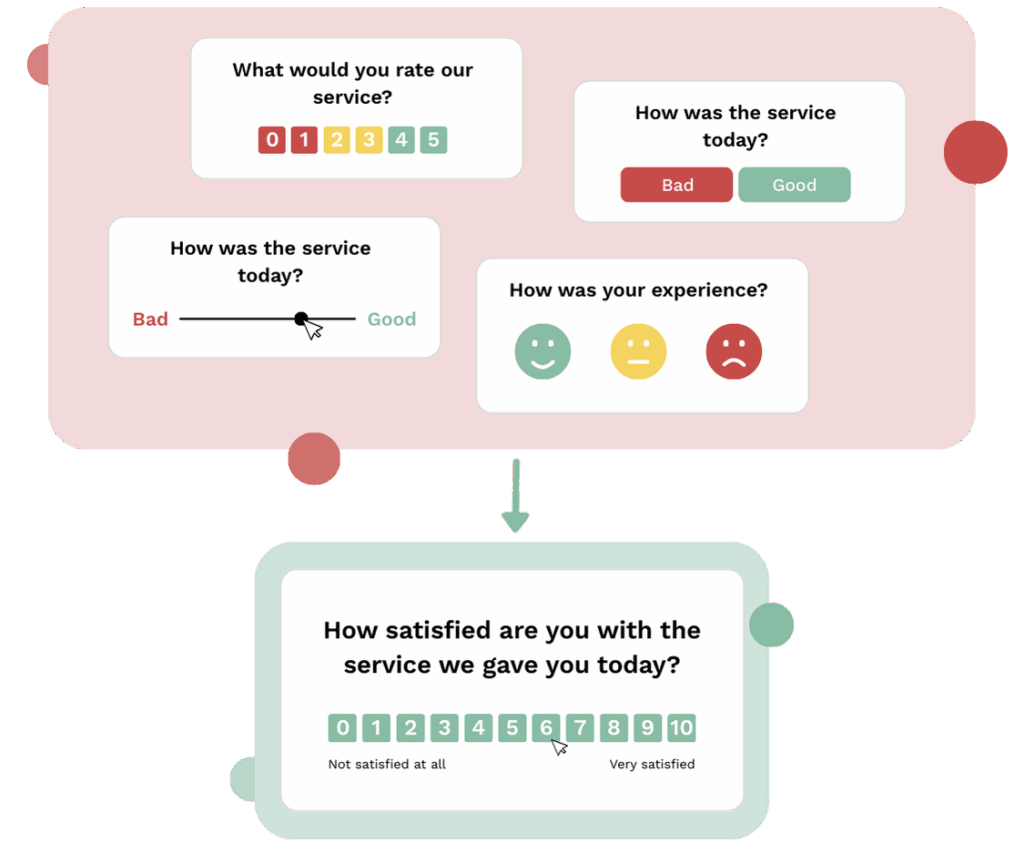
Single scale
Benefits of Single Scale CX
And Smart Question Flow
The Power of a Single Scale Experience
How nps.today’s Single Scale Smart Question Flow unifies measurement across the entire customer journey and turns feedback into operational CX.
NPS BASED SMART QUESTION FLOW
Why Single Scale Matters
Most companies rely on multiple survey tools, multiple channels, and multiple question types. The result? A fragmented customer feedback experience and complex internal reporting that never scales.
At nps.today we support any measurement scale – but we have spent more than a decade proving the value of a single, unified 0–10 NPS scale combined with our simple red–yellow–green response logic.
Promoters, passives, and detractors are universally understood across the business, enabling immediate insight and action.
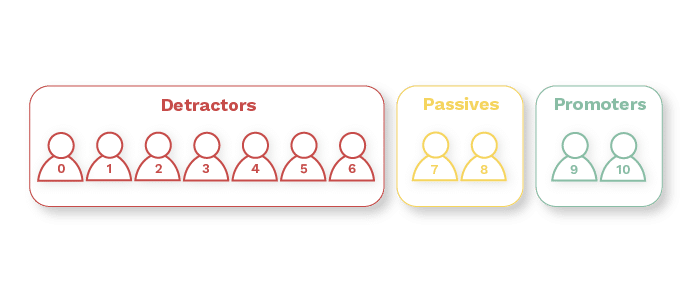
nps.today’s Single Scale Smart Question Flow ensures a consistent experience for customers and a structured, comparable dataset for your organisation. It is the foundation that makes omni-channel CX, AI-driven insight, and scalable action possible.


measure
One Scale. Every Channel. Every Touchpoint
Traditional survey setups force customers to navigate different scales, question types, and layouts depending on the channel and system used. This creates friction and reduces response accuracy.
With nps.today’s Single Scale Smart Question Flow, every survey – across email, SMS, pop-up, embedded widgets, QR codes, and direct links – uses the same intuitive 0–10 format.
Key benefits:
- Predictability increases response rates: Customers instantly recognise the format and understand how to respond.
- A truly omni-channel survey engine: No other platform enables the same NPS-based question flow seamlessly across all channels.
- Consistent experience throughout the customer journey: From onboarding to support, renewal, and loyalty tracking.
understand
A Single Scale Creates a Single Source of Truth
Fragmented scales produce fragmented insights. When every response follows the same logic, analytics become significantly more powerful.
With our unified scale, feedback classification (promoter / passive / detractor) is automated and standardized, letting your teams instantly interpret results without training or explanation.
Combined with nps.today AI and BI dashboards, organizations get:
- Comparable insights across teams, products, and journeys
- Cleaner datasets for machine learning and AI text analysis
- Easy-to-read performance patterns, drivers, and sentiment
- Less time spent preparing data — more time solving real issues
The simplicity of the scale is what unlocks the sophistication of the insights.


Act
From Insight to Action: Operational CX Made Simple
A single scale does more than streamline measurement – it enables rapid, real-world action. Because every survey campaign uses the same Smart Question Flow, integration into existing tools becomes dramatically easier.
CRM, service platforms, contact centres, ticketing systems, and even Outlook can consume the same structured response format without custom mapping.
This ensures that feedback reaches the right people in real time in the tools they already use.
What this enables:
- Automated follow-up workflows based on detractors, passives, or promoters
- Role-based notifications that support closed-loop CX
- Organization-wide visibility of customer sentiment
- Easier change management because the model is simple and universal
A unified scale empowers your employees to act faster, more confidently, and more consistently — turning CX from an insight discipline into an operational one.
Peter Tranberg Møller
Frequently asked questions about Single Scale CX
What does Single Scale CX mean?
Single Scale CX means using the same response scale, such as 0–10, across the customer journey. The questions can still measure different aspects of the customer experience, but a consistent scale makes the results easier for customers, employees and managers to understand and use.
What are the benefits of using one common CX scale?
A common scale can make surveys easier to answer, simplify reporting and create a shared language for customer experience. It also makes it easier to compare developments across channels, teams and touchpoints when the questions, target groups and measurement periods are otherwise comparable.
Does Single Scale CX mean asking every customer the same question?
No. A common scale does not require every survey to use the same question. Each question should still reflect the relevant customer experience. A company can ask about recommendation, satisfaction, customer effort or a particular service interaction while using the same 0–10 response scale.
Can NPS, CSAT and CES use the same response scale?
NPS, CSAT and CES can use a common response scale, but they measure different aspects of customer experience. NPS measures willingness to recommend, CSAT measures satisfaction and CES measures customer effort. The results should therefore remain separately named, calculated and interpreted, even when the response scale is consistent.
What is Smart Question Flow?
Smart Question Flow adapts follow-up questions to the customer’s initial score and the context of the feedback. An unhappy customer may be asked what should be improved, while a satisfied customer may be asked what worked well. This produces more relevant comments and provides a clearer foundation for action.
Can a common CX scale improve survey response rates?
A consistent and familiar scale can reduce the mental effort required to answer surveys and support a better response experience. However, higher response rates are not guaranteed. Survey length, relevance, timing, channel and wording remain important factors in determining whether customers choose to participate.
Can results from different touchpoints be compared directly?
A common scale makes comparison easier, but results still require context. A score collected after a support case does not necessarily measure the same experience as a relationship survey. Companies should compare questions with similar purposes and use customer, channel, timing and journey data to explain differences.
How does Single Scale CX support relationship and transactional surveys?
A relationship survey typically measures the customer’s overall relationship with the company, while a transactional survey measures a specific experience or interaction. Both can use a 0–10 scale, but they should be reported separately to distinguish long-term loyalty from the quality of individual touchpoints.
How can a common scale create a single source of truth?
When feedback is collected in a consistent format, it becomes easier to combine data from email, SMS, websites, apps, CRM systems and customer service. This provides a more coherent reporting foundation. A reliable source of truth also requires common definitions, accurate metadata and consistent data-governance rules.
How does Single Scale CX make customer feedback actionable?
Consistent scores can be connected to business rules, alerts and follow-up workflows. Critical responses can be routed to the responsible employee, while positive feedback can identify successful practices. Combining the score with comments and customer context helps teams prioritise actions and close the feedback loop.
Can a common scale be used for external CX benchmarking?
A common scale supports internal comparisons, but it does not automatically make results comparable with external benchmarks. Reliable benchmarking normally requires the same question, calculation method, audience, channel and measurement timing. Otherwise, methodological differences may be mistaken for genuine differences in customer experience.
How do you move from multiple scales to Single Scale CX?
Begin by mapping existing questions, scales, touchpoints and reports. Then define which measurements should be standardised and how historical data will be treated. Avoid mechanically converting old scores, as a five-point scale does not necessarily correspond directly to a 0–10 scale.
Which companies can benefit from Single Scale CX?
Single Scale CX is particularly relevant for companies collecting feedback across multiple departments, countries, products or channels. It can create more consistent reporting and make results easier to understand. It is also useful when customer feedback must be activated in CRM, service or business-intelligence systems.
Single Scale CX and Smart Question Flow
Create one clear language for customer feedback
A single 0–10 scale makes it easier for customers to respond, easier for teams to understand feedback and easier for your organization to act. See how nps.today helps you use one smart question flow across NPS, CSAT and CES surveys — across every channel, touchpoint and system.
- Unify NPS, CSAT and CES with one consistent 0–10 scale
- Create comparable feedback data across channels and journeys
- Turn promoters, passives and detractors into automated CX actions
