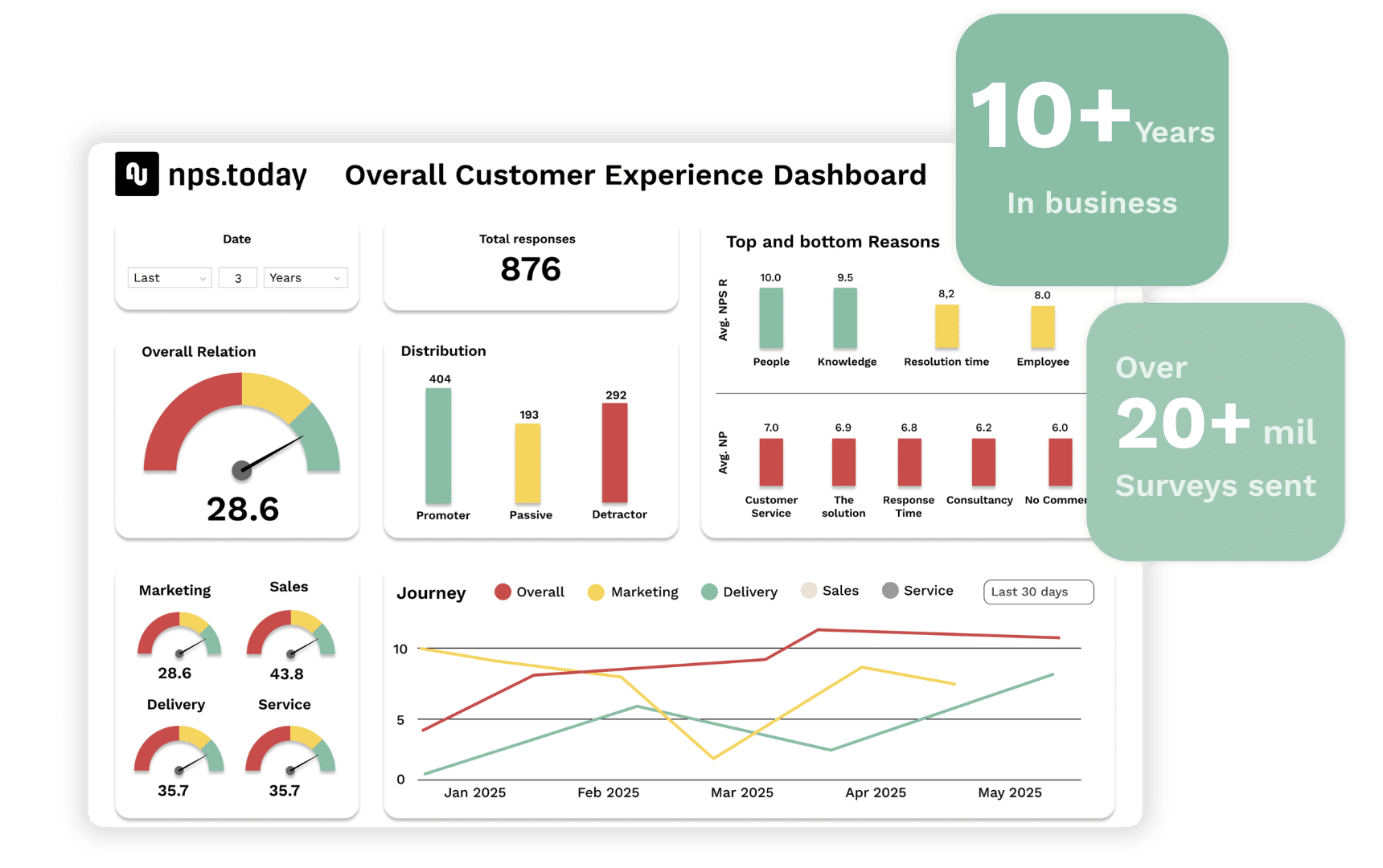
Customer satisfaction
Customer Satisfaction: How to Measure and Improve It
Customer satisfaction shows the extent to which customers’ experiences meet or exceed their expectations. It is typically measured using CSAT, NPS or CES. A useful measurement does not only help you find a score; it also helps you understand customer responses and turn them into concrete improvements.
In this guide, you will get a practical introduction to customer satisfaction, the most widely used measurement methods, concrete questions and a process for turning feedback into action.

What is customer satisfaction?
Customer satisfaction is the customer’s assessment of whether a product, a service or an overall experience met their expectations.
The assessment may concern a single touchpoint, such as a purchase, a delivery or a support case. It may also concern the customer’s overall relationship with the company.
For the company, customer satisfaction is therefore more than a score. It is an ongoing process in which you:
- Collect feedback from customers.
- Make the experience measurable.
- Find the most important reasons behind the results.
- Prioritize concrete improvements.
- Follow up and measure the effect.
A score without an objective, an owner and a follow-up plan rarely creates value on its own. Customer satisfaction is also an important part of the overall customer experience
How to measure customer satisfaction
The most widely used methods are CSAT, NPS and CES. They do not measure the same thing, so you should choose a method based on the decision the measurement needs to support.
CSAT: Satisfaction with a specific experience
Customer Satisfaction Score (CSAT) [internt link: INSERT-URL-TO-CSAT-GUIDE] measures satisfaction with a specific experience. A typical question is:
Overall, how satisfied are you with the help you received?
The question is often answered on a scale from 1 to 5. The two highest responses are normally counted as satisfied.
Formula: CSAT = number of satisfied responses / number of valid responses × 100.
If 82 out of 100 respondents answer 4 or 5, your CSAT is 82 percent. CSAT is particularly relevant after specific events such as a purchase, delivery, onboarding or a completed support case.
NPS: Willingness to recommend
Net Promoter Score (NPS) [internt link: INSERT-URL-TO-NPS-GUIDE] measures customers’ willingness to recommend the company. The classic question is:
How likely are you to recommend us to a friend or colleague?
The customer responds on a scale from 0 to 10:
- Detractors respond 0-6.
- Passives respond 7-8.
- Promoters respond 9-10.
Formula: NPS = the percentage of promoters − the percentage of detractors.
If 50 percent are promoters and 20 percent are detractors, your NPS is 30. NPS is expressed as a number from -100 to 100, not as a percentage. NPS is particularly relevant when you want to track the overall customer relationship and understand what drives recommendation and loyalty.
CES: How easy was it for the customer?
Customer Effort Score (CES) [internt link: INSERT-URL-TO-CES-GUIDE] measures how easy or difficult the customer found a specific process. A typical question is:
How easy was it to get your enquiry resolved?
CES is relevant when you want to identify and reduce friction in support, self-service, ordering or onboarding, for example. The wording and scale may vary. Therefore, use the same question and scale if you want to compare performance over time.
Which measurement method should you choose?
- Use CSAT to measure satisfaction with a specific experience.
- Use NPS to track the overall relationship and willingness to recommend.
- Use CES to examine how easy or difficult a process feels.
You can combine the methods, but avoid asking every question after every interaction. Long and frequent surveys can create survey fatigue and reduce the quality of responses.
Examples of customer satisfaction survey questions
A good survey is short, has a clear purpose and is sent while the customer can still remember the experience.
You can, for example, use these questions:
- Overall, how satisfied are you with the help you received?
- How easy was it to get your enquiry resolved?
- How likely are you to recommend us?
- What is the main reason for your rating?
- What could we have done better?
- What worked particularly well?
- Was there anything you missed along the way?
Start with one measurement question and one open follow-up question. Only add more questions if the responses will be used for a concrete decision.
Avoid questions such as: “How satisfied are you with our delivery and customer service?” The customer may be satisfied with the delivery and dissatisfied with customer service.
When two topics are combined in one question, the response becomes difficult to interpret.
Five steps for measuring and improving customer satisfaction
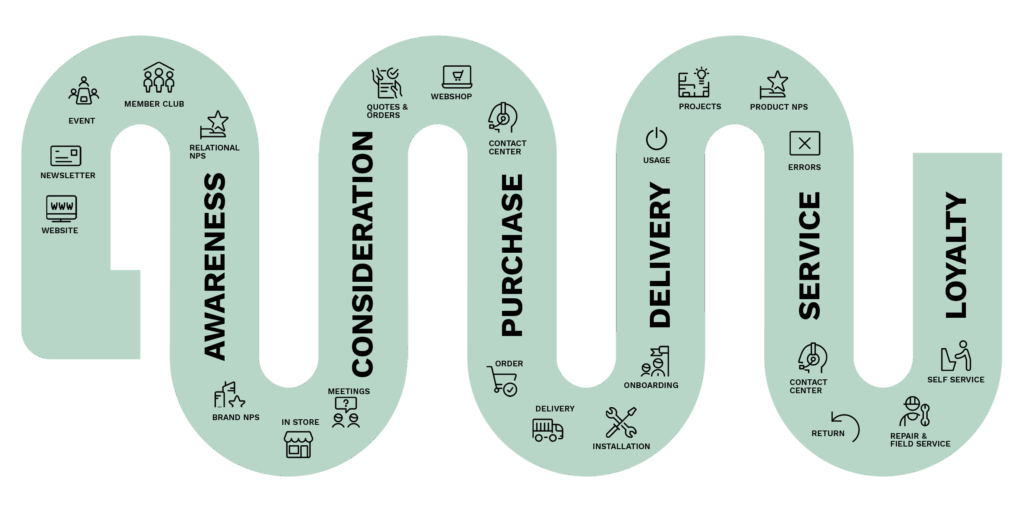
1. Map the customer journey
Identify the touchpoints that have the greatest impact on the customer’s experience. These may include ordering, onboarding, delivery, use, support, renewal or cancellation.
Then decide what the measurement should help you achieve. “We want to improve customer satisfaction” is very broad. “We want to reduce friction after the customer’s first support case” is much easier to act on.
2. Choose the method and questions
Match CSAT, NPS or CES to your objective. Use one core question, one relevant follow-up question and only the background data you need.
Before sending the survey, define who should receive it, when it should be sent, which scale will be used, how the results will be calculated and who is responsible for follow-up.
3. Choose the right time and channel
Transactional surveys should normally be sent close to the experience you want to evaluate. This may be after a delivery, a purchase or a completed support case.
Relationship surveys can be conducted at fixed intervals. The survey can be distributed through email, SMS, a website, an app or other relevant channels. Choose the channel that best fits the situation and the customer’s expectations.
4. Analyze both scores and comments
Start by checking the data: Who was invited? How many responded? Are certain customer types over- or underrepresented? Was the measurement conducted in the same way as before?
Then look at performance over time and at relevant segments such as product, channel, customer type or contact reason. Combine the scores with customers’ open comments. The score tells you where there is a problem. The comments can help you understand why.
5. Assign responsibility and follow up
Prioritize a small number of improvements at a time. Each improvement should have a clear owner, a concrete action, a deadline and a method for measuring the effect.
Follow up with customers when relevant and tell them what is happening with their feedback. Then measure again using the same method. This creates a closed feedback loop: Listen, understand, act and document the effect.
What is a good customer satisfaction score?
There is no single universally good score. A CSAT of 80 percent may be strong in one situation and inadequate in another. The result depends on factors such as industry, customer type, touchpoint, scale and timing.
Therefore, first compare the result with your previous results measured in the same way, then compare relevant customer groups and touchpoints, and finally use an industry benchmark if the method and audience are comparable.
Always report the result together with the scale, period, number of responses and measurement point. Otherwise, a precise score may give a misleading picture.
Seven ways to improve customer satisfaction
- Remove the largest recurring point of friction in the customer journey.
- Set clear expectations for the product, delivery and response time.
- Give employees access to the feedback they can act on.
- Follow up quickly on critical customer experiences.
- Improve onboarding, help content and proactive communication.
- Share feedback across product, sales, service and management.
- Measure the effect of each improvement using the same method.
Common customer satisfaction measurement mistakes
- Asking customers without deciding who will act on the responses.
- Sending long surveys after every interaction.
- Changing the question or scale and comparing the result directly with previous measurements.
- Focusing on the average and overlooking differences between customer types.
- Treating CSAT, NPS and CES as if they measure the same thing.
- Analyzing feedback but never returning to the customer.
Frequently asked questions
What is the difference between customer satisfaction and customer experience?
Customer experience includes all of the customer’s interactions and impressions throughout the relationship. Customer satisfaction is the customer’s assessment of whether a specific experience or the overall relationship met their expectations.
How often should you measure customer satisfaction?
Measure after important events and at fixed intervals when you want to track the overall relationship. The frequency should reflect how often customers use your solution and how quickly you can act on the results.
How many questions should the survey contain?
One measurement question and one open follow-up question are often enough for a transactional survey. Only add questions if the responses will be used for a concrete decision.
Can NPS be used as a measure of customer satisfaction?
NPS provides an important relationship signal, but it measures willingness to recommend. Use CSAT if you specifically want to measure satisfaction with a particular experience.
Customer Satisfaction and CX
Turn customer satisfaction into measurable improvements
Customer satisfaction only creates value when feedback leads to action. See how nps.today helps you measure CSAT, CES and NPS across the customer journey, understand what drives satisfaction and use customer insights to improve retention, loyalty and everyday operations.
- Measure customer satisfaction across key touchpoints and channels
- Understand drivers, friction and customer expectations
- Turn feedback into follow-up, dashboards and operational CX improvements